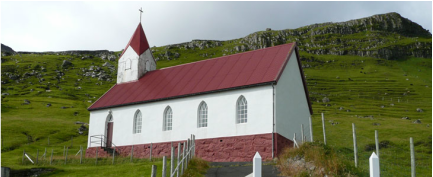
On February 5, 1818, most of the men from Kirkja—seven in total—went out fishing. On their way home, the boat took on water in rough seas and sank. Only two men were rescued, but one of them died before reaching shelter in Svínoy.
Shortly after this tragedy, when the island needed a new church—which until then had been in Kirkja—it was decided to build it in Hattarvík instead, because “there is no man living here who can be entrusted with the responsibility for the church.” The church was consecrated in 1833.
In 1881, a church inspection was conducted, which reported:
“The church in Fugloy is in poor condition. The tower is rotten, as is the wood beneath the windows.”
Further inspections followed in 1893 and 1896, but not until June 1898, when Símun Mikael Zachariassen confirmed that the church was practically unusable, did any action take place.
On August 3, 1898, the church council wrote to the Faroese Parliament, requesting a grant of 5,836.70 kroner to build a new church in Hattarvík, measuring 24 by 12 Danish ells (approximately 15 by 7.5 meters).
The construction contract was awarded to Petur í Mattalág, who signed the agreement on September 20, 1898, along with Christian Bærentsen, the governor. Petur was assisted by Magnus av Kamarinum, who handled the carpentry, and several skilled craftsmen from Hattarvík—working with stone, wood, and iron—likely contributed far beyond their required eight days of compulsory labor.
On November 9, 1899, the dean informed the governor that Heilmann, the priest from Viðareiði, had consecrated the new church on October 29. On the same day, Líggjas í Keldhúsinum and Guttormur í Geilini inspected the church and confirmed that everything was well executed.
The old church had stood in Uppi í Húsi, on the boundary between the cultivated fields and the outfields. The new church was built in the district called Niðri í Húsi, on a plot belonging to the Uttarstova farm.
(Source: J. P. Gregoriussen, “Yngru Hválvkirkjurnar”)
Independent Parish
Parish Council

 8°C
8°C